Building Pharmacy Care from 1 to 2 — evolving the product by untangling the complexity of medications, rules, workflows, and client configurations into a clearer, more supportive member experience.
RoleLead Product Designer
Timeline2024–2026 (15 months)
TeamProduct, Clinic, Solutions, Care Support, Web & Mobile Eng, external partners
Background
Pharmacy Care onboarded its first client this year and has been evolving quickly based on member feedback and client needs. Updated data from our PBM partner, Prescryptive, continues to shift what information is available — creating ongoing design and technical constraints the team must adapt to.
Challenge
Frequent data updates from Prescryptive require continuous design adjustments to align with what can be surfaced to members
Client-specific requirements add complexity and require tight coordination across internal teams and external partners
My role
Conducted user research to identify pain points and prioritize high-impact improvements
Collaborated with PM, PMM, and cross-functional partners to scope feasible solutions within data and technical constraints
Shaped the end-to-end member experience while delivering fast, pragmatic design solutions for client requests
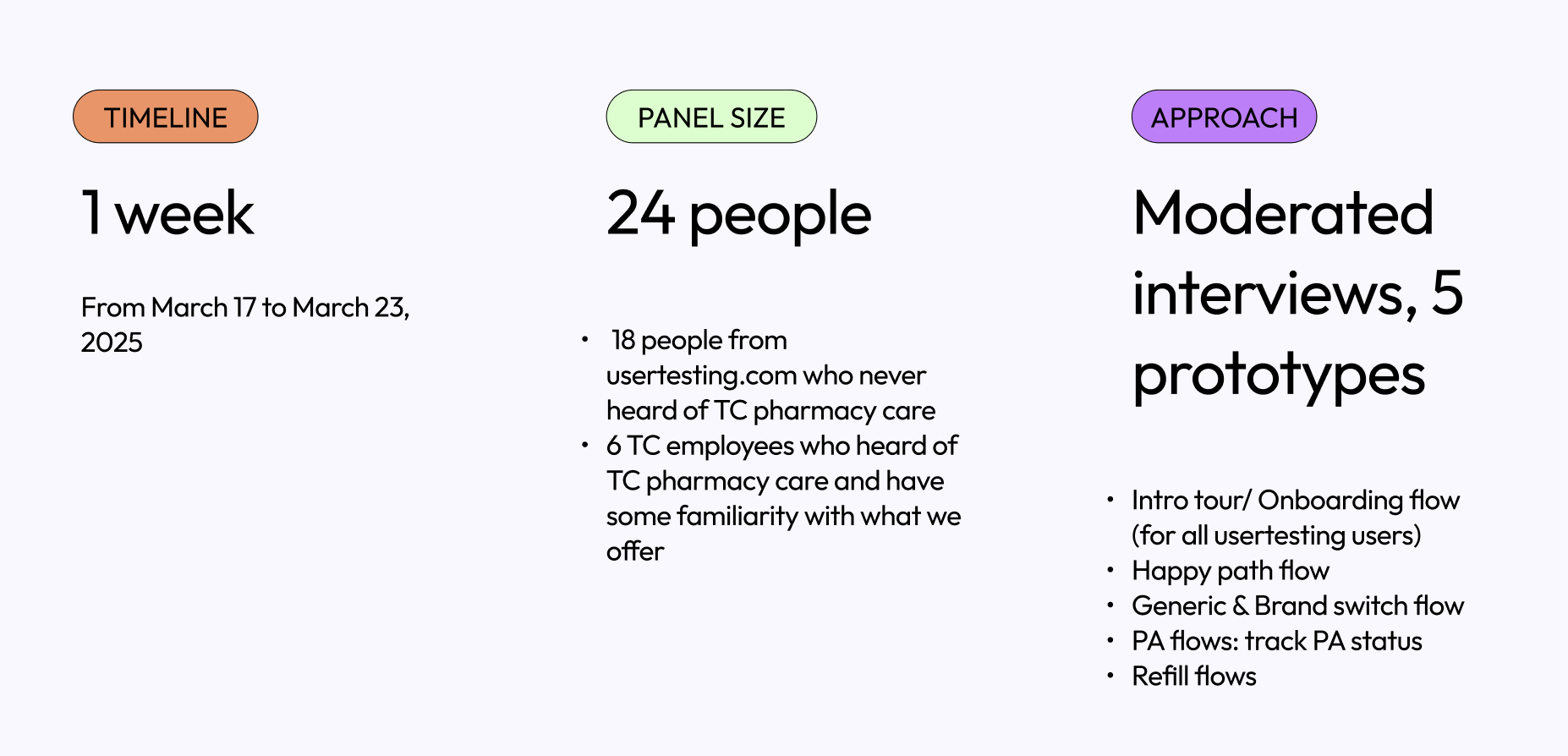
Usability testing on 5 key user flows
Conducted moderated user interviews across five key flows to uncover usability issues and understand real member behaviors, decision points, and points of confusion
Identified core pain points in the current MVP experience
Partnered with PM, Growth PM, and PMM to refine the interception journey and redesign it into a more intuitive, streamlined experience
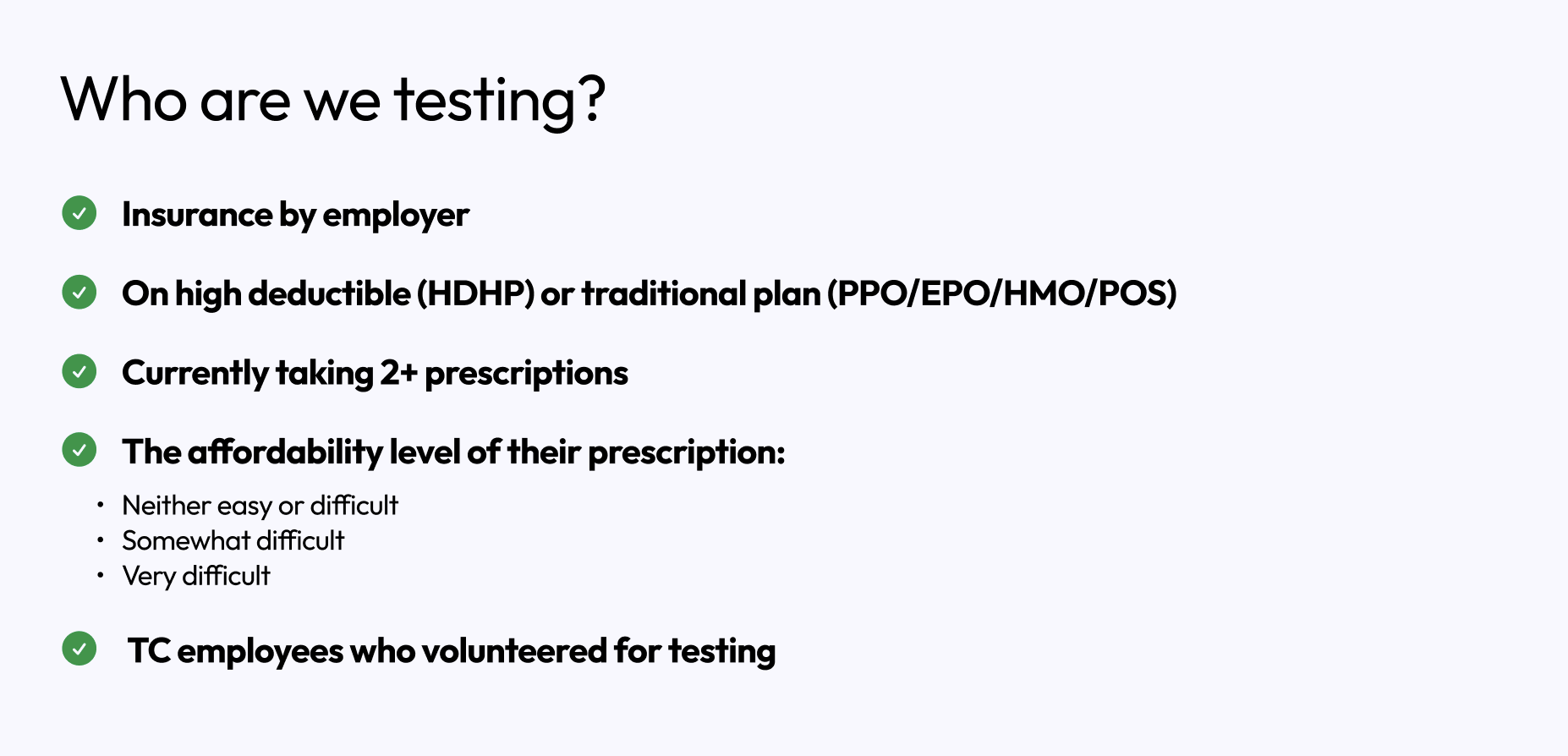
Research plan — timeline, panel size, and approachWho we tested — screening criteria
"How would this app receive prescriptions from my doctor, and how would it interact with my existing pharmacies?"— quote from a user
Persona definition & roadmap alignment
Partnered with PM to analyze insurance and claims data and define four target user personas
Iterated high-level design concepts informed by usability findings
Collaborated with PM and Solutions to shape roadmap priorities alongside client requests
Four personas
Persona 1
Premium plan, generic drugs
Not a priority group — won't use TC that much, and won't see much price difference due to insurance coverage.
Want: Convenience
Generic, alternative options upfront
Various pharmacy options, especially mail order
Persona 2
HDHP plan, generic
Will see a big price difference and go with the lowest-cost option, regardless of insurance or Rx savings card.
Want: Save big & save more over time
Saving through various pharmacies, including mail order
Keep saving with notifications
Generic & alternative options upfront
Use the price search tool to compare and transfer prescriptions to a lower-cost pharmacy
Save on dispensing fees (30 days vs. 90 days)
Persona 3
Premium plan, Tier 3+ brand users
May have a higher copay for brand drugs, and deal with prior authorization.
Want: Reduce the copay price, transparency
PA tracker
Generic, alternative options upfront
Persona 4
HDHP plan, Tier 3+ & brand drug users
Drugs are very expensive for this group — they can see big price differences across pharmacies and deal with PAs all the time.
Want: Save money, and have transparency about PA status and coverage clarity
Saving through various pharmacies, including mail order
Generic & alternative options upfront
Use the price search tool to compare and transfer prescriptions to a lower-cost pharmacy
PA tracker
Feature
Savings opportunities from claims
Problem: we receive multiple savings data points from our partner and need to surface them through key pharmacy flows to help drive utilization.
What I did
Explored ideal-state solutions and wireframed a redesigned pricing card
Partnered with PM to scope a lighter-lift version based on engineering capacity and timeline
Designed supporting UI elements for consistency across the full flow
Outcome: a lightweight update surfacing savings opportunities on Rx details and the medicine cabinet at key moments, and enabling price comparison when searching for a next fill.
Feature
Pharmacy search & save
The API returns a large volume of data, and members had no clear way to tell which was the right brand or generic equivalent — with five different drug types returned: Generic, Brand, Alternative, Biosimilar, and Specialty.
Problem: ship a drug search flow that manages complex data points and B2B limitations — empowering members to understand pharmacy practices and find savings through a transparent, guided experience.
Identified gaps in the current search flow and ran competitive research on brand/generic presentation
Collaborated with PM, Engineering, and the PBM team to confirm data accuracy and reliable 1:1 brand-to-generic mapping
Designed UI across multiple scenarios for when and how to surface switch information
Conducted user research to validate member reactions to auto-switching behaviors
Part 2 — alternatives & biosimilar medications
Mapped key scenarios for when members might consider lower-cost alternatives
Conducted user testing to validate understanding, expectations, and reactions to alternative options
Defined display logic across four drug types and designed UI patterns that clearly differentiate each
Feature
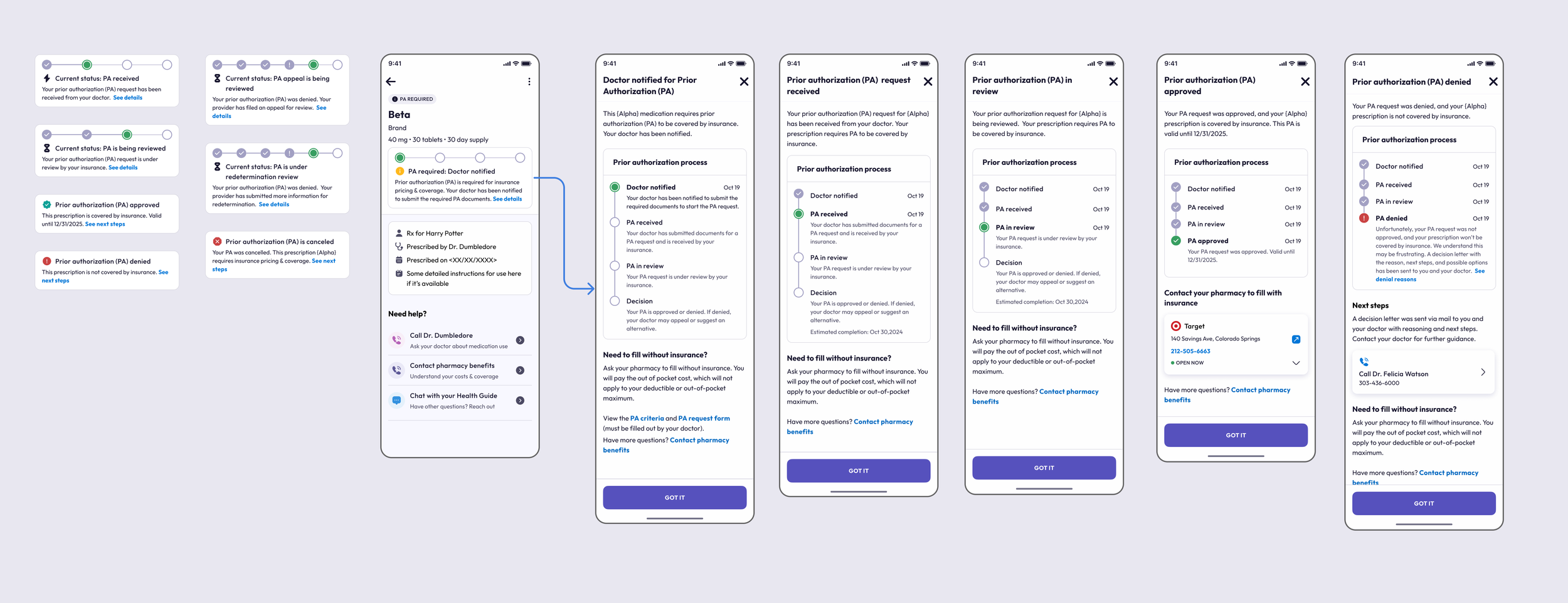
Prior authorization pizza tracker
Problem: more prior-authorization data became available, but the current UI didn't fully support it, creating gaps that needed to be addressed through redesign.
Process
Worked with engineers and PM to identify new PA data and how it should fit into the existing flow and UI
Applied usability testing insights to reduce member friction and create a more guided experience
Worked with PMM to simplify and tighten product copy
Outcome: refined the pizza-tracker pattern with new data to clearly represent each step of the prior-authorization flow.
Feature
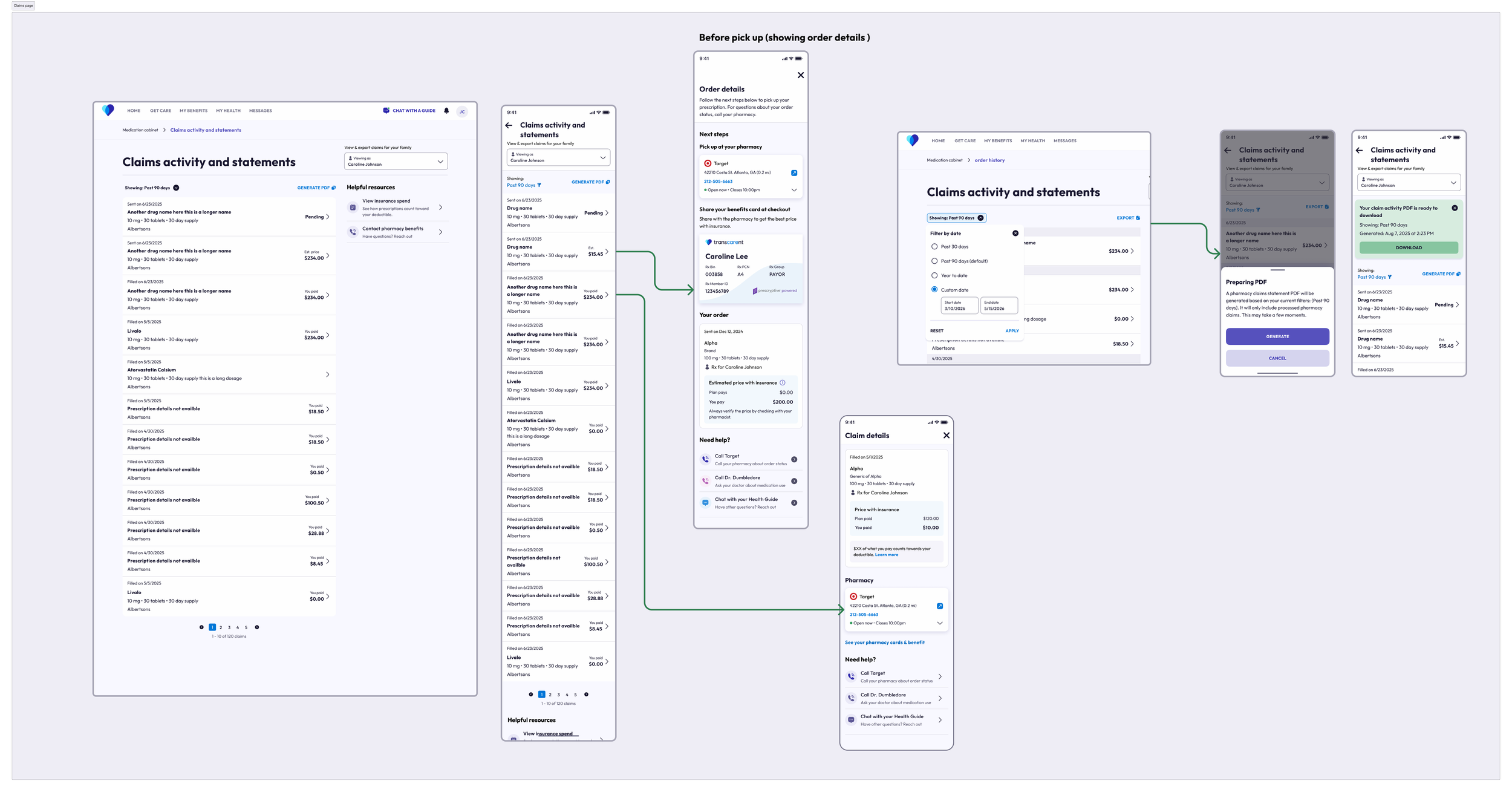
Claim activities & flexible export
Problem: the existing claims activity page only showed claims by month, leading to empty states when medication schedules didn't align with calendar months — activity was fragmented and statuses were unclear.
What I did
Conducted competitive research (e.g. bank statements) on flexible date selection and export patterns
Mapped claim scenarios (pre- and post-pickup) to clarify status for each medication
Collaborated with developers to accommodate PDF generation delays and created a calendar UI component
Outcome: members can now view all claims on a single page, select custom date ranges, download PDFs, and clearly understand each claim's status.
Feature
"How does pharmacy benefit work" education piece
Problem: usability testing revealed members didn't understand what the product offered — as a PBM, the service felt confusing compared to typical price-checking tools.
What I did
Synthesized usability testing findings to identify pain points and the easiest path to understanding the benefit
Aligned with PMM to plan an educational approach and marketing materials
Designed step-by-step guidance to make the benefit easier to understand and navigate
Outcome: a new page aligned with marketing materials that sets clear expectations, educates members, and guides them through the pharmacy benefits experience.
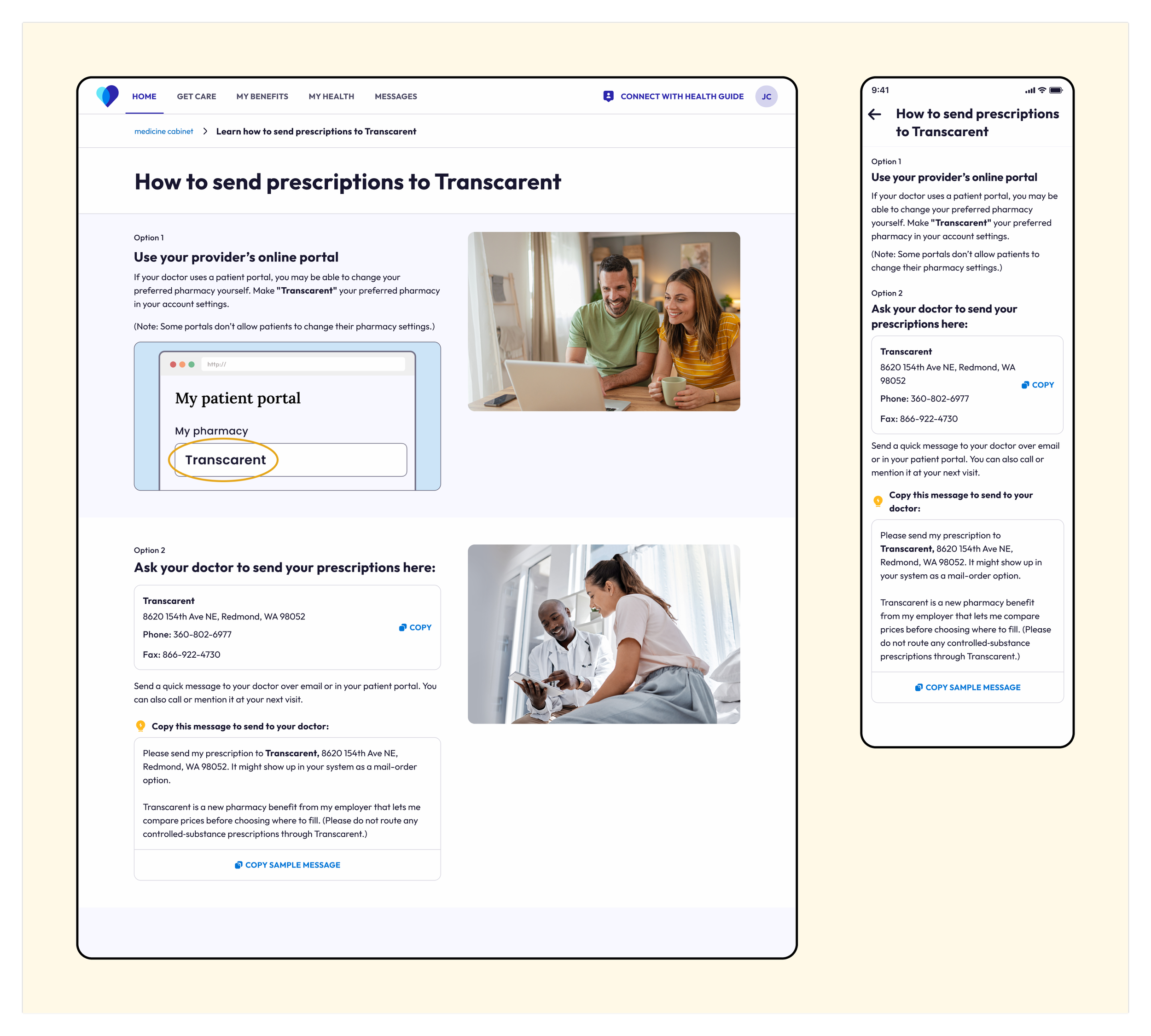
"How to send prescriptions to Transcarent" — desktop and mobile